We are living through a moment of profound global realignment. In the face of war and rising authoritarianism, the institutions and frameworks meant to protect fundamental rights appear increasingly sidelined. The promises of 1989-1991 are unravelling; from Russia’s war of aggression against Ukraine and internal repression to rising militarization and systematic disinformation, there is a return to tactics reminiscent of Stalinism and the darkest days of the Cold War.
Fifty years on, the international consensus, built within the format of the 1975 Helsinki Accords, is now unravelling. The collapse of trust in multilateral institutions, the resurgence of authoritarianism, the rollback of civic space, and the erosion of human rights frameworks have all contributed to the dismantling of what was once seen as the
cornerstone of European security architecture. The Organization for Security and Collaboration in Europe (OSCE), the embodiment of the Helsinki process, struggles to maintain even the slightest relevance in the face of open war, geopolitical fragmentation, and systemic disregard for international law.
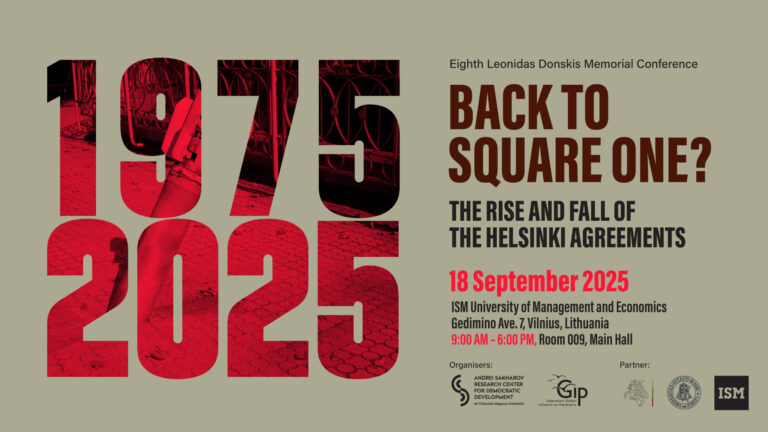
The Eighth Leonidas Donskis Memorial Conference will look back at the process how during the Cold War the Helsinki Accords became reality, compare the situation in the early 1970s with that of now and try to answer the question whether a new set of agreements is at all feasible and what needs to be done to further that goal. It is a stepping stone to the Sixteenth International Sakharov Conference in May 2026 that will focus on the “closing of the circle”: the development of the human rights movement and civil society in Central and Eastern Europe, the USSR and in Europe in general, as a direct consequence of the Helsinki Accords, and the current closing of space for civil society, a process that has been ongoing over the past decade.